
Sales Funnel How to Use — Complete 2025 Guide (Beginner-Friendly)
Updated: 2025 • Length: 5000+ words (educational) • Audience: Beginners learning affiliate & digital marketing
What is a Sales Funnel?
At its core, a sales funnel is a step-by-step journey that guides a prospect from initial awareness to a desired action — usually a purchase, sign-up, or lead submission. Think of it like a path you design for your visitors so they move naturally from “I heard about you” to “I trust you enough to buy”.
Why the word “funnel”?
Because you start with a broad audience at the top (many people might see your post or ad) and narrow down to people who take action — the tip of the funnel (customers). The funnel helps you manage and optimize that journey.
Why Use Sales Funnels (Simple Benefits)
- Predictable customer flow: Funnels let you estimate how many visitors you need to reach a revenue goal.
- Better conversions: Focused pages + targeted messages convert better than a generic homepage.
- Automation: Follow-ups and email sequences run automatically — you earn while you sleep.
- Testing & scaling: Split tests let you find what works; then you scale the winning approach.
Sales Funnel Stages — Step-by-step
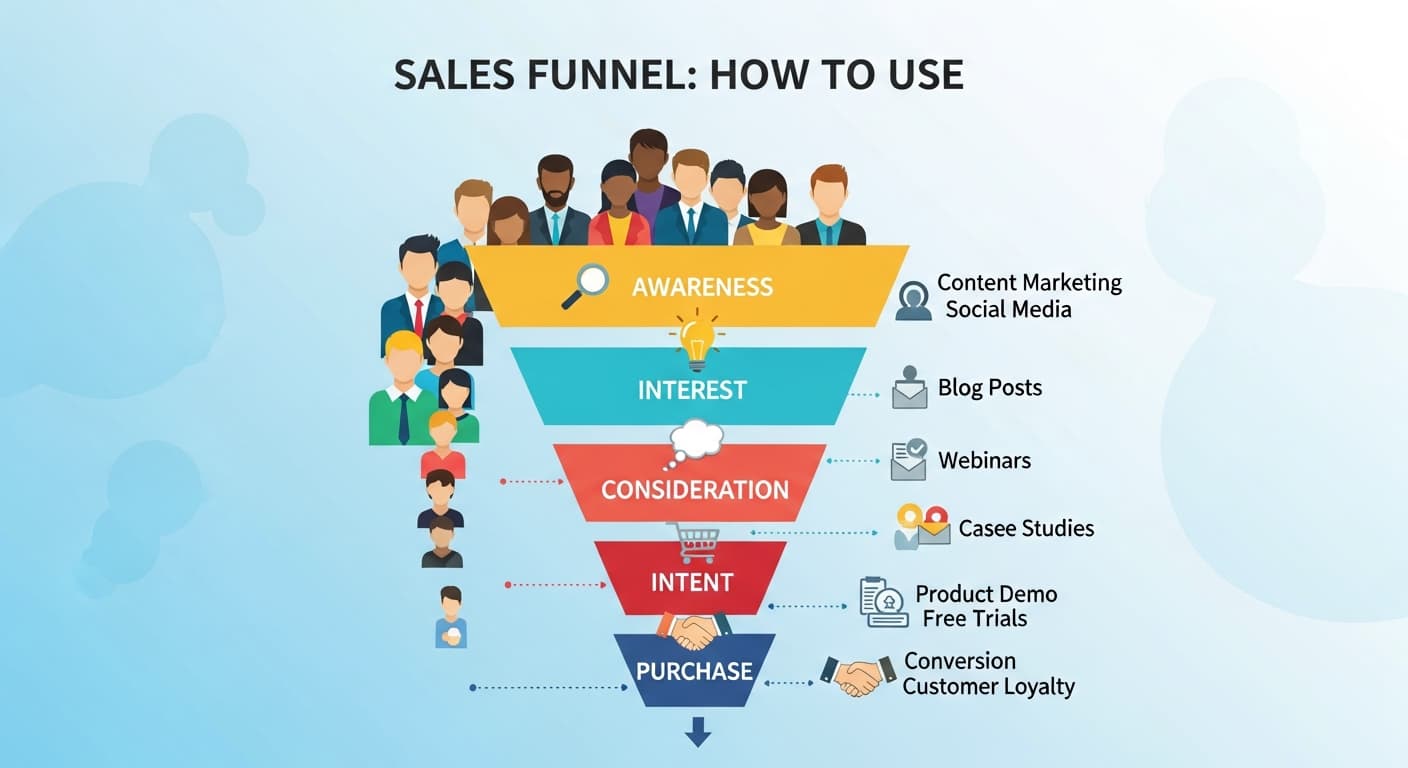
1. Awareness (Top of Funnel — TOF)
This is where people discover you: blog posts, social posts, YouTube, search, ads. The goal is to get relevant traffic.
2. Interest (Middle of Funnel — MOF)
Here visitors are curious. You offer helpful content (ebooks, webinars, comparison guides) that encourages them to share contact details (usually email).
3. Decision (Bottom of Funnel — BOF)
Now the prospect evaluates options and you provide an irresistible offer: product, trial, consultation, discount, or a clear call-to-action.
4. Action & Retention
Action is the purchase or signup. Retention is often overlooked — keep customers with onboarding emails, tutorials, and cross-sell offers.
How to Build Your First Funnel (Beginner Checklist)
Below is a practical, step-by-step approach that you can follow this afternoon. Each step includes the “why” and “how”.
Step 1 — Pick a clear goal
Decide what action you want: email signups? a product sale? a demo booking? This single goal will shape your funnel design.
Step 2 — Create a compelling lead magnet
Offer something of value in exchange for an email — a checklist, mini-course, template, or cheat sheet. See the Lead Magnets section for ideas.
Step 3 — Build a focused landing page
Remove distractions. One headline, one benefit, one CTA. Use a simple opt-in form and social proof if available.
Step 4 — Setup an email autoresponder sequence
Start with a welcome email + 3–5 nurture emails that deliver value and gently introduce your main offer.
Step 5 — Drive traffic
Choose one source first (SEO blog post, YouTube, Facebook ads, or influencer shoutout). Don’t spread yourself thin.
Step 6 — Measure & improve
Track conversion rates at each step (visit → opt-in → click → sale). Improve the weakest step first.
Step 7 — Scale what works
When a funnel converts consistently, increase traffic and test higher budgets or new audiences.
Lead Magnets & Offers That Convert
A lead magnet is the bridge between curiosity and exchange of contact info. It must be high-value and immediate.
Types of lead magnets that work well
- Checklist / Cheat sheet: Short, actionable steps (e.g., “5-step funnel checklist”).
- Template / Swipe file: Landing page copy, email templates, ad creatives.
- Mini-course (email-based): 3–5 lesson drip course delivered by email.
- Webinar / Training: Live or recorded masterclass with a clear CTA at the end.
- Calculator / Quiz: Interactive tools that give personalized results.
What makes a lead magnet convert?
Solve a single clear problem fast. Keep it short and usable. Packaging matters — a well-designed PDF or video will convert better than a plain text file.
Landing Pages & Forms — Best Practices
Headlines that convert
Use benefit-led headlines. Tell the reader what they will get and how it helps. Example: “Get the 7-Step Funnel Checklist to Double Your Opt-Ins”.
Forms — keep them short
Ask for the minimum info. Name + email is usually enough. Longer forms reduce conversion — you can gather more details later in the funnel.
Social proof
Use testimonials, small numbers (like “1,200 marketers use this”), or logos. Be honest — fake proof hurts your long-term rankings and trust.
Mobile-first design
Most traffic is mobile. Ensure the CTA is visible without scrolling and forms are optimized for touch.
Speed matters
Slow pages kill conversions and SEO. Use compressed images (WebP where possible), minimal scripts, and a fast host.
Email Nurturing Sequence — Templates & Examples
Email is the most valuable asset in a funnel. Here’s a simple 5-email sequence you can use for beginners.
Day 0 — Welcome (deliver the lead magnet)
Say thank you, deliver the promised resource, and set expectations for future emails.
Day 2 — Value + Story
Share a short story about a problem the lead likely has and how others solved it. Keep it helpful, not salesy.
Day 4 — Case study / Example
Show a real result — a short case study or a before/after. This builds credibility.
Day 7 — Soft offer (value ladder)
Introduce a low-risk offer: a free trial, low-cost course, or a consultation. Use testimonials and clear next steps.
Day 12 — Reminder + urgency
Remind them about the offer and add a limited-time reason to act (bonus, closing window). Always remain truthful.
Subject: Here’s your 7-Step Funnel Checklist ✅

Hi {FirstName},

Thanks for signing up — here’s your checklist: [download link]

Quick tip: Start with Step 1 today — it takes only 30 minutes and sets the foundation.

I’ll send a follow-up with a short case study showing how others used the checklist.

To your progress,
— GrowthToolsPro
Traffic Strategies: Paid & Organic
Traffic fuels your funnel. Start with one channel and get predictable results before diversifying.
Organic channels (low cost)
- SEO blog posts: Target long-tail keywords related to your lead magnet and funnel topic.
- YouTube: How-tos and short tutorials that link to your landing page in the description.
- Social (X/Threads/LinkedIn/Instagram): Micro-content that points to your landing page.
Paid channels (fast but costs money)
- Facebook/Instagram ads: Great for lead magnets and cold traffic.
- Google Search ads: Good for high-intent queries (use for BOF offers).
- YouTube ads: Reach viewers with educational video ads and direct them to a landing page.
How to pick the first channel
Pick the channel where your audience already spends time. If you sell B2B, consider LinkedIn or search. For consumer offers, social ads or YouTube usually work well.
Conversion Optimization & KPIs
Track the right KPIs. Don’t blindly optimize the wrong metric — focus on revenue per visitor.
Essential funnel KPIs
Where to start optimizing
Find the largest drop-off step (highest leak) and fix that first. If opt-ins are low, improve headline, offer, or page speed. If clicks from emails are low, rewrite subject lines and first paragraph.
Split testing basics
Test one change at a time (headline, CTA copy, button color — but headline first). Run tests long enough to reach statistical significance before deciding.
Tools & Tech Stack (recommended — beginner friendly)
Below is a small stack that balances simplicity and power. You can start free or with low-cost tiers.
Landing page & funnel builders
- systeme.io — Simple all-in-one funnel builder, email automation, courses, and payments (soft mention for convenience). Use with no pressure; choose what fits your needs.
- Other builders: ConvertKit pages, MailerLite, Leadpages, or a WordPress + Elementor setup.
Email autoresponders
- MailerLite, ConvertKit, ActiveCampaign (as you scale)
Analytics & tracking
- Google Analytics (GA4), Google Tag Manager, and simple conversion tracking in your ad accounts
Design & creatives
- Canva for quick images, Figma for advanced mockups
Common Mistakes & How to Avoid Them
- Too many choices — Avoid page clutter; one clear CTA performs better.
- Missing tracking — Always track conversions and source. Without data you guess.
- Overcomplicated funnels — Start simple; add complexity only when you have results.
- Ignoring mobile — Test funnels on mobile devices early.
- Not following up — Email sequences increase conversions dramatically.
Scaling Your Funnel — When & How
Scale when your funnel profits at a small test level. Scaling means increasing traffic and ad spend, or expanding to new channels.
Safe scaling checklist
- Stable conversion rates for 2–4 weeks
- Clear CAC below target LTV
- Reliable fulfillment and customer support
- Automated onboarding to reduce manual work
Scale tactics
Duplicate your top-converting ad sets, increase budgets slowly (10–20% daily), expand lookalike audiences, and localize creatives for new geographies.
Mini Case Study — Simple Affiliate Funnel That Converts (Beginner)
Example: You promote a low-cost SaaS trial using a funnel.
Funnel outline
- Blog post targeting “best [tool] for beginners” (SEO traffic)
- CTA in post to download a free “Tool Setup Checklist” (lead magnet)
- Email sequence that shows how to use the tool & includes a soft product mention
- Final email links to the trial page (affiliate link)
Why it worked
- High-intent content matched to a relevant lead magnet
- Helpful nurture sequence built trust before soft recommendation
- Low friction CTA (free trial) increased conversions
Use this same approach for any affiliate product: content → lead magnet → nurture → soft recommendation.
30-Point Funnel Checklist (Printable)
- Define funnel goal
- Identify target audience
- Choose the funnel type (lead gen / sales / webinar)
- Create lead magnet
- Write benefit-led headline
- Design mobile-first landing page
- Add short opt-in form
- Include honest social proof
- Setup email autoresponder
- Write welcome email
- Write 3 nurture emails
- Create thank-you page with next steps
- Integrate tracking (GA4 / GTM)
- Test form submits
- Compress images (WebP where possible)
- Set up ad account (if using paid traffic)
- Run small traffic test (200–500 visits)
- Check mobile conversions
- Analyze funnel drop-off
- Fix largest drop-off
- Run A/B test on headline
- Optimize email open rates
- Optimize email click-throughs
- Measure CAC vs LTV
- Scale slowly when profitable
- Create onboarding sequence for customers
- Collect testimonials
- Plan next product or upsell
- Document funnel steps in a playbook
Tip: Keep the checklist visible in your project board and tick items as you go.
FAQs — Common Questions (JSON-LD Schema below)
Q: How long does it take to build a simple funnel?
A: You can build a minimum viable funnel in a few hours — landing page, lead magnet delivery, and a basic email autoresponder. A fully optimized funnel can take several weeks of testing.
Q: What is a good opt-in rate?
A: For a well-targeted funnel, opt-in rates between 20–40% are common for high-value lead magnets. For weaker magnets 5–15% is typical. Context matters (traffic quality, offer relevance).
Q: Can I use WordPress for funnels?
A: Yes. WordPress with a page builder (Elementor, Gutenberg blocks) plus an autoresponder works. But all-in-one builders like systeme.io or other dedicated funnel builders can speed the process.
Q: Do I need to run ads?
A: Not at first — SEO and organic content can work fine. Ads accelerate results but cost money. Start with organic traffic and add paid channels after your funnel proves a positive ROI.
Conclusion & Next Steps
You now have a complete, practical guide to build and use sales funnels in 2025. Start with a tiny, testable funnel: one lead magnet, one landing page, and a 3-email sequence. Measure results, fix the biggest leak, and scale when profitable.
Next actions (first 7 days)
- Pick a clear funnel goal (day 1)
- Create or repurpose a lead magnet (day 2)
- Build a landing page and setup autoresponder (day 3)
- Drive 200–500 visitors from one traffic source (days 4–7)
- Analyze and adjust
Related reading: Metatrader to Interactive Brokers — Order Copier Guide and Best Algeprime 2025/2026.