
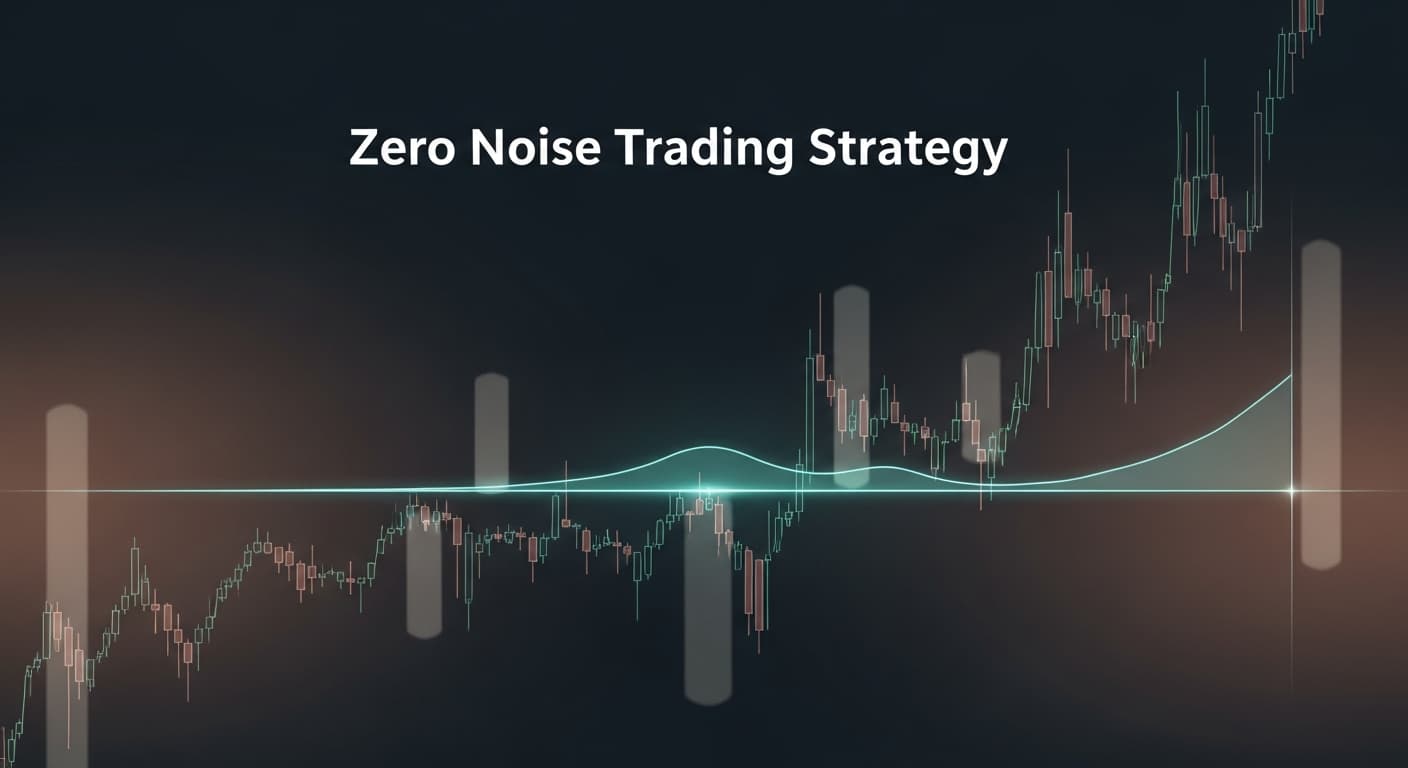
Zero Noise Trading Strategy – Complete Trading Course (2025)
A practical, step-by-step course & strategy guide to reduce market noise, sharpen trade signals, and manage risk — ideal for traders, investors, students, and beginners.
Affiliate disclosure: This post contains affiliate links. If you buy through the links, I may earn a commission at no extra cost to you. I only recommend products I believe are helpful. Always do your own research before trading.
1. Overview: What is Zero Noise Trading?
Zero Noise Trading is a practical approach focused on filtering out short-term price fluctuations (the “noise”) to identify higher-probability trade opportunities. Instead of reacting to every tick, the strategy emphasizes:
- Clear multi-timeframe alignment
- Robust entry filters (time of day, volatility, trend confirmation)
- Simple but effective indicator combinations
- Strict risk management
The course titled “Zero Noise Trading Strategy – Complete Trading Course (2025)” teaches traders how to implement this approach from scratch: chart setups, signal rules, trade management, backtesting, and psychological routines. It’s aimed at traders who want a repeatable system with fewer false signals and cleaner trade execution.
2. Why Zero Noise Matters
Markets can be chaotic — intraday whipsaws, news spikes, and algorithmic blips create rapid price moves that often produce false entry signals. Zero Noise trading reduces these false triggers by:
- Using confirmation across timeframes to avoid impulsive trades
- Filtering signals with volatility and volume checks
- Prioritizing trades with favorable reward-to-risk ratios
Key takeaway: Less noise = fewer losing trades, clearer setups, and better risk control.
3. Course Curriculum — Module by Module
The course is organized into practical modules. Each module includes video lessons, downloadable templates, and guided examples that you can apply immediately.
Module 1 — Foundations & Market Mechanics
Understand how markets move, timeframes, volatility regimes, and why “noise” appears. Lessons cover order flow basics, liquidity, and the difference between noise and trend.
Module 2 — Indicator Toolkit
Step-by-step setup of the core indicators used in Zero Noise: moving averages, ATR (Average True Range), ADX (trend strength), custom noise filters, and volume-based validation. The course emphasizes simple combinations rather than many conflicting indicators.
Module 3 — Entry & Exit Rules
Clear, rule-based entries and exits with examples. Includes time-of-day filters, confirmation candles, stop placement methods, and profit-target logic. Every rule is coded visually so you can scan charts quickly.
Module 4 — Risk Management & Position Sizing
Position sizing calculators, maximum drawdown rules, risk-per-trade models, and how to scale positions safely. Includes downloadable Excel and Google Sheets calculators.
Module 5 — Backtesting & Statistical Edge
How to build a simple backtesting plan, analyze results, and understand statistical significance. The course shows how to test your setups and evaluate expectancy.
Module 6 — Market-Specific Adjustments
How to adapt Zero Noise rules for stocks, futures, forex, and crypto, including session-specific rules and liquidity considerations.
Module 7 — Live Trade Walkthroughs
Multiple live trade breakdowns showing entries, stops, scaling, and trade management. The instructor explains the rationale in plain language so beginners can follow.
Module 8 — Psychology & Routine
Daily routines, pre-market checklists, journaling templates, and simple cognitive techniques to reduce emotional trading.
Module 9 — Continued Support
Community access, Q&A sessions, and periodic update lessons for market regime changes.
4. Core Strategy Components & Indicators
Zero Noise uses a small set of complementary filters rather than 10+ indicators. The goal is clarity. Here are the most important components:
Trend Filter (Multi-timeframe)
Use a higher timeframe moving average (e.g., 50–200 EMA on daily or 4H) to define the primary trend. Only take trades in the trend direction on lower timeframes.
Noise Filter (ATR + Volatility Band)
ATR measures volatility. The course recommends dynamic filters using ATR-based bands to ignore small fluctuations and only act when price moves exceed a volatility threshold.
Confirmation Candle Pattern
Instead of trading on a single breakout candle, require a confirmation candle (close beyond level with volume support). This reduces false breakouts.
Volume & Liquidity Check
Validate entries with volume spikes or liquidity conditions. For illiquid instruments, widen stops or avoid trading during low liquidity windows.
ADX (Trend Strength)
ADX helps to decide whether a trending or range approach is suitable. A higher ADX supports trend-following entries; a low ADX suggests avoiding breakout bets.
Time-of-Day Filter
Specific times (e.g., first 30 minutes of session or news windows) are filtered out or treated differently. The course offers ready-made rules by market (US session, Asian session, etc.).
5. Step-by-step Setup (Platforms & Tools)
This course prioritizes accessibility. You can implement Zero Noise on most charting platforms (TradingView, MetaTrader, ThinkorSwim, NinjaTrader, etc.). Here’s a recommended setup:
- Charting platform: TradingView (free + optional Pro tools) or your broker’s platform.
- Indicators: 50 EMA, 200 EMA, ATR (14), ADX (14), Volume profile or on-chart volume.
- Templates: Import the course templates for clean charts and auto-highlighted levels.
- Position size tool: Use the included Google Sheet calculator or a plugin in platform for position sizing by risk %.
Below is a simple checklist to apply before you start trading live:
- Check higher timeframe trend alignment (daily / 4H).
- Confirm current ATR suggests tradable volatility.
- Ensure no high-impact news during planned trade window.
- Set stop and target before entry; never edit them on impulse.
6. Real Trade Examples & Case Studies
The course includes detailed trade walkthroughs. Below are two simplified examples to illustrate the Zero Noise logic.
Example A — Trending Stock (Swing Trade)
- Higher timeframe (daily) shows uptrend: price > 200 EMA and 50 EMA rising.
- On 4H chart, price pulls back near 50 EMA with ATR within normal range.
- Volume increases on the reversal candle and ADX > 20 confirming trend strength.
- Entry: close above the reversal candle; Stop: below the recent low; Target: 2–3x stop distance or structure level.
Example B — Range Break (Intraday)
- Daily trend is neutral but 1H chart forms a consolidated range with low ATR.
- Zero Noise rule: avoid trades until ATR expands by at least 25% (reduces false breakouts).
- On breakout with increased volume and confirmation close, take a scaled entry with tight stops.
Each example in the course shows exact chart screenshots, entry/exit timestamps, and alternative management choices to adapt for risk tolerance.
7. Risk Management & Position Sizing
Risk management is the backbone of Zero Noise. The course teaches a conservative, consistent model:
Rule of Thumb
Risk no more than 0.5%–2% of account per trade depending on your risk tolerance. Use ATR to determine stop distance, then calculate position size so that the dollar risk equals your predefined percent.
Scaling & Partial Profits
Scale out of positions at pre-defined targets to lock in gains while leaving a runner. This preserves win rate and improves psychological comfort.
Drawdown Rules
Implement maximum drawdown limits: e.g., stop trading for the day/week if drawdown > 4% to avoid revenge trading. The course supplies a drawdown-management checklist.
Get Access8. Trading Psychology & Routine
Even the best rules fail without discipline. Zero Noise teaches simple routines:
- Pre-market checklist (levels, news, volatility check)
- Set daily trade limit and max trades
- Micro-breaks & journaling after each trade
- Weekly review to spot bias and systemic issues
Psychology lessons are practical: journaling templates, short mindset exercises, and scripts to use when tempted to overtrade.
9. Backtesting & Journal Templates
The course provides a beginner-friendly backtesting plan plus downloadable spreadsheets and a journal template. Key sections include:
- Trade log fields: date, instrument, timeframe, entry, stop, target, R:R, outcome, notes
- Monthly performance summary: win rate, average R, expectancy
- Edge evaluation: how many trades you need to reach statistical confidence
Backtesting reduces curve-fitting risk by focusing on a narrow set of rules that generalize across markets.
10. Pros & Cons
Pros
- Clear, rule-based approach reduces guesswork
- Suitable for beginners and intermediate traders
- Focus on risk management and journal-driven improvement
- Market-agnostic — applicable to stocks, futures, forex, crypto
- Includes templates and live trade walk-throughs
Cons
- Not a quick-riches system — requires discipline and practice
- Some advanced modules assume familiarity with basic charting
- Results vary by market and individual execution quality
11. Pricing & Value
Pricing and offers change frequently. The course often includes bonuses like templates, calculators, and community access. Evaluate value by checking:
- Included materials (videos, scripts, templates, sheets)
- Access length (lifetime vs subscription)
- Bonuses and community support
- Refund policy & guarantee
Tip: If you’re new, look for a money-back guarantee or short trial to test the methodology risk-free.
Get Access12. Frequently Asked Questions (FAQ)
Q: Is Zero Noise trading suitable for intraday traders?
A: Yes. The course shows intraday adaptations and time-of-day filters. It emphasizes avoiding low-liquidity periods and waiting for clear ATR expansion to trade breakouts.
Q: Do I need coding experience?
A: No. The course provides step-by-step indicator settings and chart templates. Advanced sections discuss simple scripts for automation but are optional.
Q: Can I use the system for crypto?
A: Yes, but the course recommends wider stops and volatility adjustments for crypto due to higher baseline volatility.
Q: What is the expected learning curve?
A: Beginners can implement basic rules within a few weeks; consistent performance typically requires 3–6 months of disciplined practice and backtesting.
Q: Is there community support?
A: The Complete Course often includes community access and Q&A sessions. Check the offer page for exact details.
Get Access13. Conclusion & Final Verdict
Zero Noise Trading Strategy – Complete Trading Course is a thoughtfully structured program for traders who want to trade with clarity, discipline, and better risk control. It doesn’t promise overnight riches — instead, it focuses on repeatable rules, practical setups, and habit formation.
Who it’s best for: beginners who want structure, intermediate traders who struggle with false breakouts, and investors looking for rules to manage entries and exits.
Final rating: 4.8 / 5 — Recommended for those committed to learning and applying a rule-based approach.